Article: How to Style Your Next Shoot with Flat-Lay Photo Backdrops
How to Style Your Next Shoot with Flat-Lay Photo Backdrops
Creating beautiful flat-lay photography is all about the details. The right lighting, composition, props, and color palette can transform a simple collection of objects into a polished image that tells a story.
But before you place a single prop, there's one important decision to make: your backdrop.
A thoughtfully chosen flat-lay photo backdrop provides the foundation for your composition, helping create consistency while allowing your subject to remain the focus of the image. Whether you're photographing wedding stationery, jewelry, cosmetics, food, handmade products, or branded content, your background can dramatically influence the final look.
At Gallery Mats, our Flat-Lay Photo Backdrops were designed to give photographers and content creators a simple, portable surface for building beautiful flat-lay scenes.
Here are some of our favorite ways to style them.
1. Start With the Right Flat-Lay Backdrop
Before adding props, consider the mood you want your photograph to communicate.
A soft, neutral backdrop creates an understated and elegant foundation that's ideal for wedding details, jewelry, stationery, and luxury products. Darker surfaces can introduce drama and contrast, while warmer tones can create a more organic or inviting atmosphere.
The key is choosing a backdrop that complements your subject rather than competing with it.
If you're photographing a colorful product, a neutral surface can help those colors stand out. For minimalist products or neutral stationery, introducing subtle texture into the backdrop can add depth without distracting from the composition.
Gallery Mats Flat-Lay Photo Backdrops are available in a selection of colors and finishes, including linen and faux-suede surfaces, allowing you to quickly change the character of your photograph without rebuilding your entire setup.
2. Build Your Composition Around a Hero
Every strong flat-lay photograph needs somewhere for the eye to land.
Choose your primary subject first and position it before introducing secondary elements.
For a wedding photographer, that might be the invitation suite or rings. For a product photographer, it could be the product itself. For a jewelry designer, the hero may be a necklace, ring, or pair of earrings.
Once your main subject is positioned, gradually build around it.
Secondary objects should support the story rather than compete for attention.
3. Layer Your Flat-Lay
One of the easiest ways to make flat-lay photography feel more dimensional is through layering.
Instead of placing every object directly on your photography backdrop, introduce subtle differences in height.
Try layering stationery, photographs, envelopes, fabric, ribbons, ring boxes, trays, books, or other small styling pieces.
Even a small difference in height can create shadows that give the photograph more depth.
The result is a composition that feels intentional rather than simply being a collection of objects arranged on a flat surface.
4. Introduce Texture
Texture can make a huge difference in product and detail photography.
This is especially important when you're working with a relatively simple or monochromatic color palette.
Consider combining materials such as:
-
Linen
-
Silk or ribbon
-
Handmade paper
-
Dried or fresh flowers
-
Wood
-
Metal
-
Glass
-
Stone
-
Velvet
-
Faux suede
The backdrop itself can also become part of that texture.
Our Real Linen Flat-Lay Backdrops offer a subtle woven appearance, while our Faux-Suede Flat-Lay Backdrops provide a softer surface with a more luxurious feel.
The goal isn't necessarily to add more objects. It's to create visual variety through the materials already within the scene.
5. Use Props With Purpose
Props are one of the most useful tools in flat-lay photography—and one of the easiest things to overdo.
Before adding an object, ask yourself whether it contributes to the story.
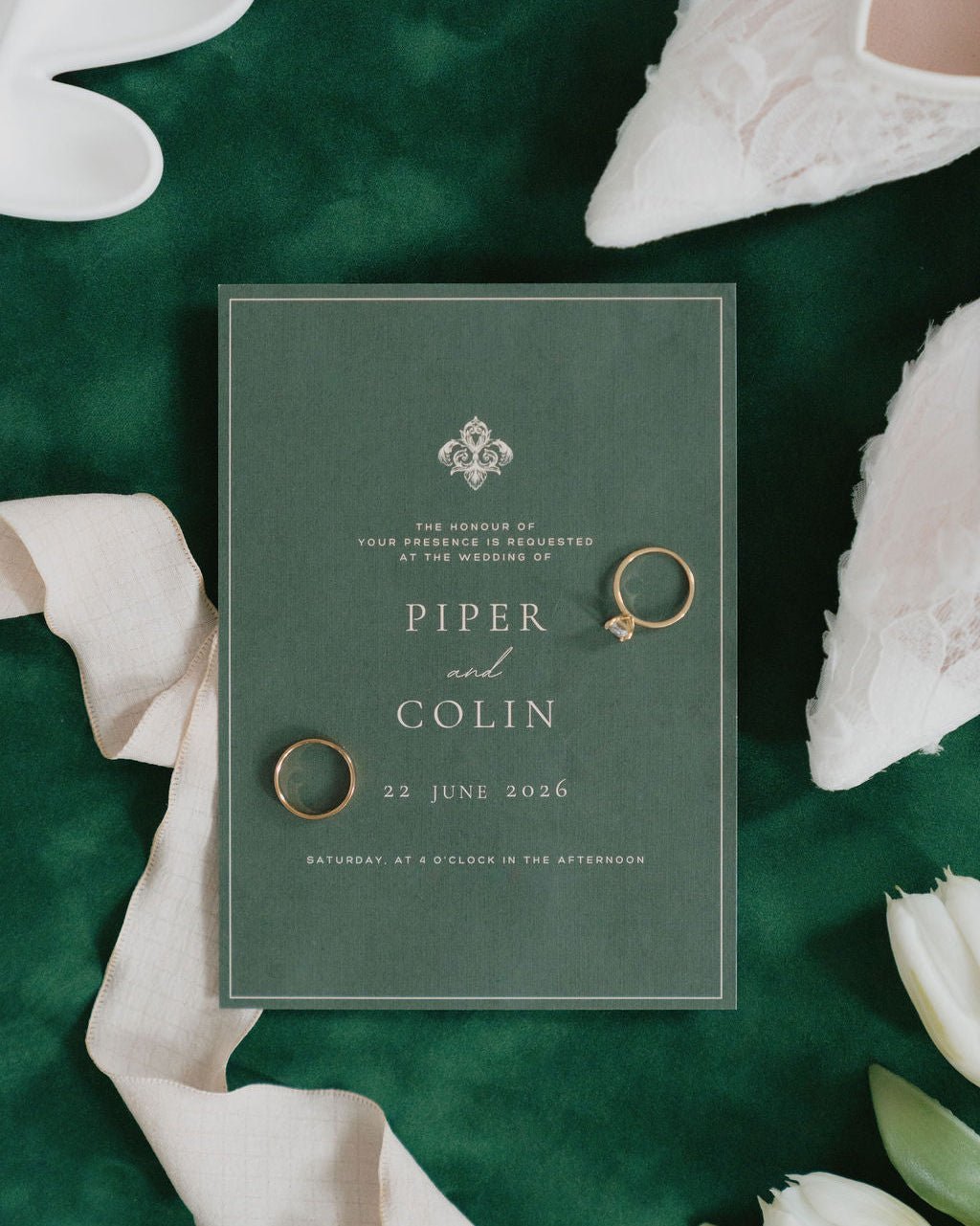
A wedding invitation might be paired with rings, ribbon, flowers, stamps, or a ring tray.
A skincare product could be photographed alongside ingredients, towels, water droplets, or natural materials.
A handmade product might work beautifully with tools or materials associated with how it was created.
These small details give viewers additional information about the product, brand, or occasion without requiring words.
6. Pay Attention to Your Color Palette
Strong flat-lay styling often uses a relatively controlled color palette.
That doesn't mean everything needs to match.
Instead, look for colors that work together.
You might choose one dominant color, one complementary color, and a neutral backdrop. Alternatively, you can create a nearly monochromatic composition and allow one object to provide a strong accent.
Your flat-lay backdrop plays an important role here because it occupies such a large portion of the photograph.
When in doubt, start neutral and build outward.
7. Create Depth With Directional Light
You don't necessarily need a complicated lighting setup to create beautiful flat-lay product photography.
A large window can be one of the best light sources available.
Position your setup near the window and allow the light to travel across your composition rather than directly toward it. This creates subtle shadows around stationery, jewelry, flowers, and other props.
Those shadows help reveal texture and depth.
If the shadows are too strong, use a white reflector, foam board, or another bright surface opposite the window to gently bounce light back into the scene.
For more control, photographers can recreate the same effect using a large, diffused artificial light source.
8. Don't Be Afraid of Negative Space
You don't need to fill every inch of your backdrop.
Negative space can be one of the most effective elements in a flat-lay composition.
Leaving open space around your subject helps separate individual objects and can create a cleaner, more sophisticated photograph.
It's also particularly useful when creating images for websites, advertisements, magazines, or social media campaigns because the empty area can later accommodate text, logos, or other graphic elements.
Sometimes removing one or two props will improve your photograph more than adding another.
9. Shoot More Than One Composition
Once you've built a flat-lay setup, take advantage of it.
Start with your primary composition, then make small changes.
Move the hero product.
Remove a prop.
Add another detail.
Rotate the composition.
Photograph the entire scene and then move closer for detail shots.
You can also leave intentional negative space on different sides of the frame.
A single well-designed flat-lay setup can quickly produce an entire collection of photographs for websites, social media, advertisements, product listings, and marketing campaigns.
10. Keep Your Flat-Lay Photography Setup Simple
One of the biggest advantages of using a dedicated flat-lay photography backdrop is consistency.
Instead of searching for a suitable table, floor, countertop, or wall every time you photograph a product, you have a predictable surface that can be positioned wherever the light is best.
That makes flat-lay backdrops particularly useful for photographers, small businesses, wedding professionals, jewelry designers, makers, and content creators who regularly need to produce new imagery.
A simple setup might include your backdrop, one light source, a reflector, your camera or phone, and a small collection of styling props.
From there, the creative possibilities are nearly endless.
Create Your Next Flat-Lay with Gallery Mats
Great flat-lay photography doesn't require an elaborate studio.
It starts with a strong foundation.
Gallery Mats Flat-Lay Photo Backdrops provide a portable, reusable styling surface designed for photographers and creators who want to quickly build polished product and detail photographs.
Available in Linen and Faux-Suede finishes, our rigid backdrops are easy to position, store, transport, and swap between setups, making it simple to create multiple looks during a single shoot.
Whether you're photographing wedding details, stationery, jewelry, cosmetics, food, handmade products, artwork, or branded content, the right backdrop gives you a clean canvas to start creating.
Style it. Shoot it. Make it yours.